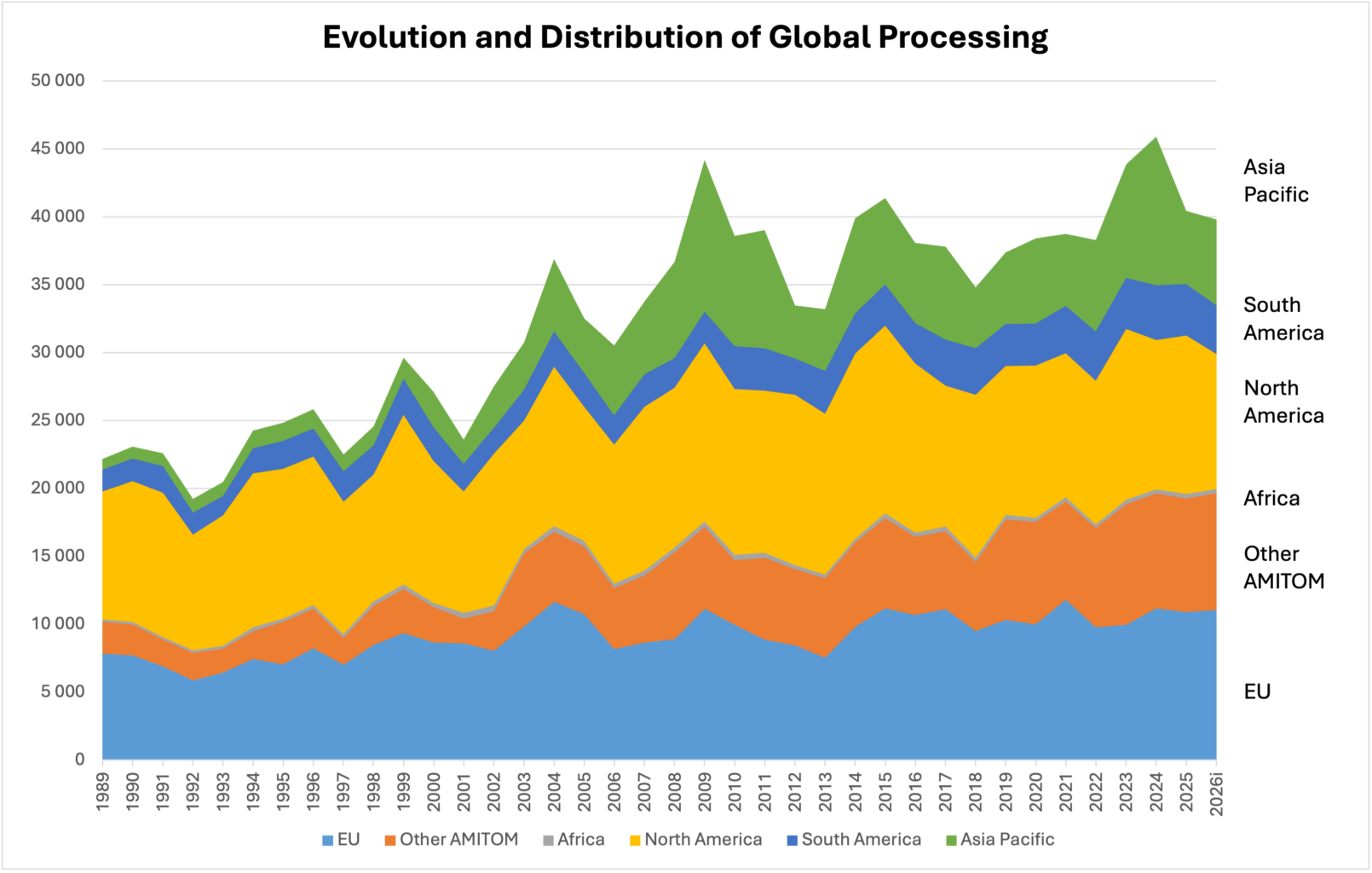
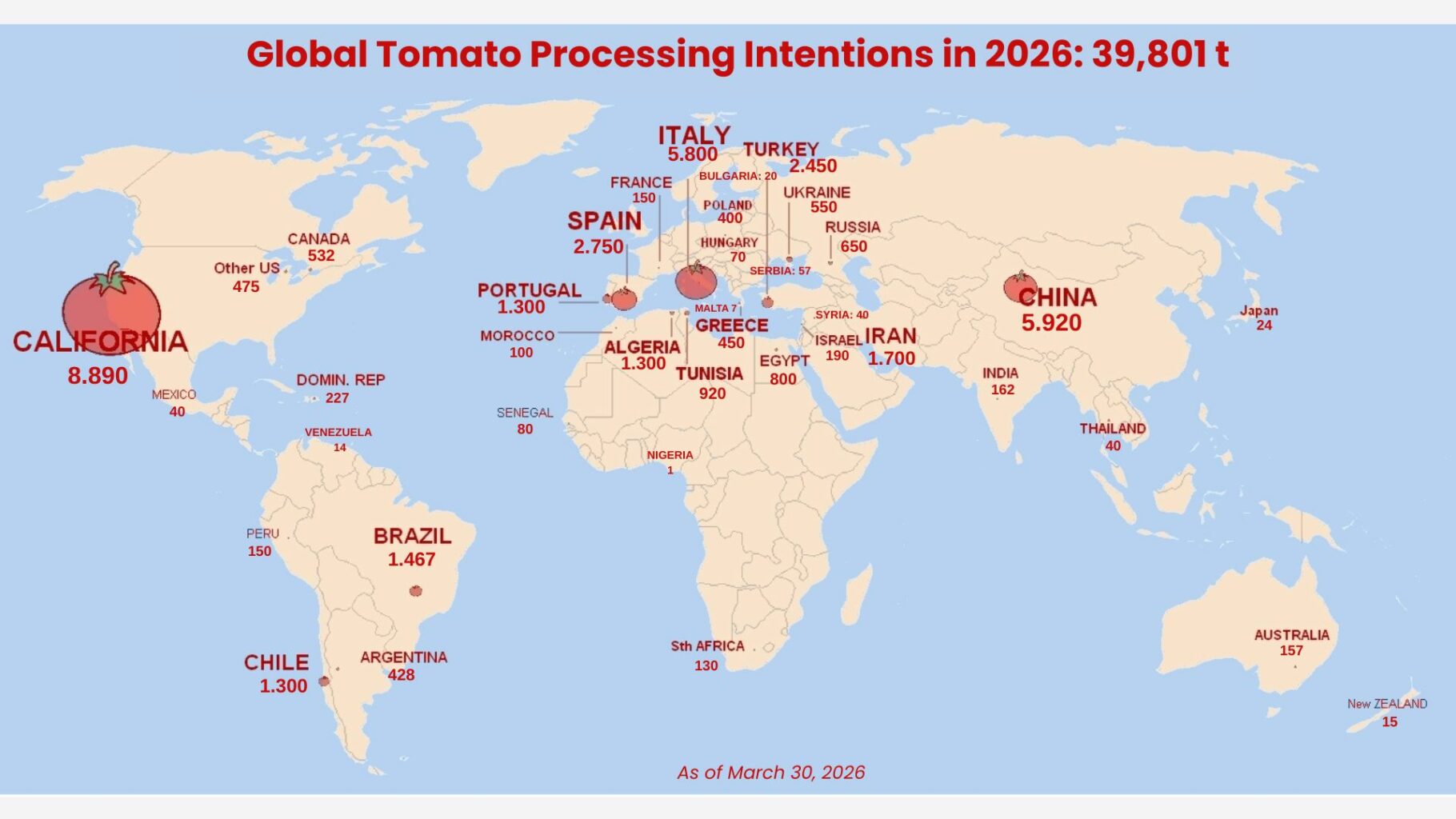
Amitom countries
Bulgaria
Due to the rise of energy and fertiliser prices (+40%) and the planned refurbishment of the largest factory Balkan , the volume processed in 2026 should see a 50% reduction to 20,000 tonnes. The weather is currently a bit wet, but it should not be an issue to start planting towards the end of April as planned.
Egypt
The forecast remains the same at 800,000 tonnes.
France
The forecast is still uncertain as price and volume negotiations are still ongoing but expected to reduce to 150,000 tonnes probably with a reduction of conventional surfaces, while organics should increase, for a total of less than 2,000 hectares. The weather is not good as there have been a lot of rains throughout the winter and fields are still wet. Transplanting should have started this week but may be delayed to next week as it is currently windy and cold.
Greece
The weather is nice and fields have been prepared for planting which should start this week in the South and next week in the Centre. The main worry is the effect of the war on energy and fertiliser prices despite some government assistance. The forecast remans 450,000 tonnes. Prices have been made public and average about 115 euros/tonne delivered, with some variations.
Hungary
The current forecast is still circa 70,000 tonnes. The plantings in the nurseries started last week.
Iran
There is currently a high level of uncertainty and communication is difficult. Iran has temporarily banned the export of tomatoes and tomato-based products under the current circumstances. More information will be sent when available.
Italy
The situation in Northern Italy is favourable in terms of overall water availability (we had a rainy winter) and also regarding soil preparation. The forecast is maintained at the level issued in February (3 million tonnes).
The negotiation of volumes and economic conditions between processors and growers’ associations experienced a series of delays and difficulties due to changed energy cost conditions (which affect not only the fuels used for farming operations but also cultivation costs such as technical inputs including nitrogen fertilizers). The negotiations finally closed on Friday 27 March with an average reference price of €137/ton ex-field, including premiums for late delivery and for services.
In Centre-South Italy, the situation is better than last year, the water availability is fine in several areas, but while the Occhito dam is in a better situation, it is not enough.
As usual, the processors and growers’ associations were waiting for the North to set their price and only after they will start negotiations.
The international situation with the blockade of Hormuz is creating many concerns about the consequences for the costs of diesel and fertilizers, and this will not help negotiations.
The forecast is updated to 2,8 million tonnes, so the total expectation for Italy is now 5.8 million tonnes.
Portugal
Portugal was affected by several storms which resulted in floods in all the tomato growing area. The borders of some fields by the river Tagus were damaged which means water flooded land. At the moment we are having good Spring weather which will help for drying some areas still with water. The start of transplant is planned for the 6th of April. Therefore, for the time being we keep the estimation for 1.3 million tonnes. Prices for the season are about 106-107 euros per tonnes ex field as reported in the press.
Serbia
So far, the season has been good, and expectations are for 57,000 tonnes to be processed if yields of about 90 t/ha are reached like last year.
Spain
The winter has been good in terms of rain and reservoirs in Andalusia and Extremadura are full which should ensure a good water supply for the next four years. The weather is now good and planting started last week in Andalusia and will next week in Extremadura. Prices have been agreed at about 107 euros/tonne ex field or 115 euros/tonne delivered but some farmers are now asking for an increase due to the rising costs of energy and fertilisers. The forecast is raised to 2.75 million tonnes.
Tunisia
At this stage, we do not yet have any processing forecasts for the current season. The only data currently available relates to the planned area under cultivation, estimated at around 15,300 hectares.
Turkey
From the information gathered surfaces may be slightly reduced in the South and stable or slightly increased in the Bursa area. The weather has been wet last week, and more rain is expected next week so planting il be a bit later than usual. There are still stocks of products, mainly canned paste and exports are reduced due to unfavourable exchange rate. The production is expected to be between 2.4 and 2.5 million tonnes. There are no public figures on prices, but contracts are currently about 525 TRL delivered, equivalent to 100 euros, although famers are requesting increased following rising costs, or they may reduce the fertiliser use, which may impact yields.
Ukraine
Fields are ready, growing in nurseries started in time, transplanting is scheduled for the end of April. Fertilisers are available, but prices are way from reasonable, and energy price s are also up. The forecast will likely be reduced in May depending on the real situation on the ground. The battle line remains the same as a year ago.
Other WPTC countries in the Northern Hemisphere
California
Planting for the early part of the crop began in February and the weather provided ideal conditions. As we moved into March, we have seen warmer than normal temperatures which has been very good for plant growth for fields already planted. The warmer temperatures also have resulted in some minor pauses in planting and at this point it shouldn’t be an issue. The precipitation received for this year has not been what we had hoped earlier in the winter. This will result in lower water allocations in some areas of the state. Due to the reduction in acres for this season, the lower allocations will not impact acreage for this season.
Price negotiations continue at this point.
Canada
Preliminary contract intentions for 2026 are 586,000 short tons (532,000 metric tonnes). The past few weeks have seen typical early‑spring weather, including fluctuating cold‑to‑mild temperatures, overcast conditions, intermittent rainfall, and occasional wet snow, with several nights falling below freezing. Planting is set to begin in early to mid May.
China
As of the end of March, the planted area of processed tomatoes is about 50,670 hectares. It is estimated that the volume processed will be 5.92 million tonnes. The downward revision is primarily attributable to farmers’ cautious outlook for market and low planting enthusiasm.
Japan
Planting will begin in stages from the end of March, starting in Tokai region. There is no change to the forecast of 400 hectares to be planted for a volume to be processed of 24,000 tonnes.
Other WPTC countries in the Southern Hemisphere
Argentina
Argentina’s processing tomato crop for the 2026 season is currently at approximately 75% harvested area, with the campaign entering week 13 of harvest. The planted area is estimated at 5,120 hectares, and under normal yield conditions—aligned with multi-year averages—total production is projected at around 425,000 tonnes.
Yield expectations remain strong and stable, supported by the high performance observed within the Tomate 2000 program, which has helped offset the impact of recent hail events. Current yields are tracking 10–15% above last season, confirming a sustained improvement compared to 2025. Overall crop condition remains good, and fruit quality has been very satisfactory so far.
Weather conditions have remained broadly consistent throughout the season, characterized by warm, dry, and windy conditions with generally low rainfall. However, in mid-January, a severe hailstorm impacted an unusually large area in Villa Aberastain (San Juan), affecting approximately 400 hectares, with damage ranging from light to very severe.
Harvest activities began in mid-December and have progressed steadily. While some advancement was observed around weeks 5 and 8, operations have since normalized. The campaign is progressing in line with expectations and is projected to conclude by late April, depending on industrial scheduling and remaining field conditions.
Within the Tomate 2000 program, which represents a significant share of the national crop, the current situation shows a slightly more advanced stage, with 76% of the adjusted surface already harvested (2,160 ha out of 2,842 ha). Estimated total production within the program stands at approximately 293,228 tonnes, of which 229,535 tonnes have already been harvested, leaving around 63,700 tonnes still to be collected.
The average yield of harvested fields within the program is currently estimated at 106 t/ha, confirming the strong productive performance observed this season.
The Tomate 2000 program continues to increase its share within national production, currently accounting for approximately 68–69% of total estimated output. This growing participation is primarily driven by the excellent performance of its supervised area, where higher and more stable yields have consistently outperformed the national average. As a result, the program is playing an increasingly central role in supporting overall production levels in Argentina.
A clear regional dynamic is observed within the program. In San Juan, the crop is significantly more advanced, with 86% of the surface already harvested and only 14% remaining, reflecting its role as an early production zone. Notably, harvested yields have been exceptional, reaching approximately 111 t/ha, confirming the strong performance of the region this season.
In contrast, Mendoza, due to its cooler conditions, represents a later production area, with 54% harvested and 46% still pending, concentrating a significant share of the remaining harvest. Despite this later development, harvested yields have also been very strong, averaging around 91 t/ha, highlighting a solid productive performance under more challenging thermal conditions.
Australia
Harvest is nearing completion across the nation, but progress has been hampered by widespread rainfall. The combined intake stands at approximately 138,000 tonnes with total production now expected to reach around 157,000 tonnes. This is a decrease from earlier forecasts. Operations are expected to conclude shortly after Easter.
Brazil
The current forecast is 1.467 million tonnes from 15,150 hectares.
The conflict in Iran will have likely impacts on the fertilizer market, especially nitrogen fertilizers, according to a Rabobank study (2025). According to the study, approximately 45% of global urea exports transit through routes associated with the Persian Gulf, in addition to 25% of ammonia, 20% DAP, 10% MAP, and almost 30% of global sulfur circulating through these maritime routes. Diesel has already risen 60% in one week in the agricultural market.
Chile
There have been heavy rains in different tomato areas around mid-March, with more than 100 mm over 24h in some places on 16 March. Last week, all factories were working, but with lower volumes. It is too early to assess the full impact the rain may have, and the forecast is kept at 1.3 million tonnes.
South Africa
South Africa experiences dry heat wave conditions in the summer production areas. Already 75% of the summer crop has been delivered, with an average of 5.8 brix, and the summer processing season should end in late April. Currently 25% of the total South African volumes were processed at due date.
In the Northern winter production areas of Limpopo, flooding conditions are experienced, and transplanting should end in April. Winter deliveries are scheduled from April to end September.